Grow
Hobby or Business? The Day Your Retreats Have to Start Paying You
When the thing you love for free has to start covering the rent. How to tell if your retreats are a business yet — and the four things that have to be true before you go full time.

There is a version of you running retreats right now that is technically a business and emotionally a hobby. You charge people. Money changes hands. And yet at the end of the year you could not tell anyone, including yourself, whether the whole thing made a dime.
That is the in-between place. It is the most dangerous place to live, because it feels like progress while quietly costing you money. Let's name the moment it has to change, and what changes with it.
The tell that you are still treating it like a hobby
A hobby pays for itself in good feelings. You run a retreat, people cry at the closing circle, you come home glowing, and you do not look too hard at the bank account because the glow is the payment.
A business pays you in money you can live on. Not someday. This year. The hobby version asks "did everyone have a transformative time." The business version asks that too, and then asks "did this retreat pay me for the four months of work it took to fill it."
If you have never asked the second question, you are not running a small business yet. You are funding an expensive labor of love. That can be fine for a season. It cannot be the plan.
The decision nobody makes on purpose
Almost nobody sits down and decides to go full time. It happens by drift. You add a retreat, then another, you quit the side gig because there is no time, and one day you look up and this loose thing you love is the only thing paying you. By then the decisions you skipped are overdue and expensive.
So make the call on purpose instead. Going from hobby to business is not about how much you love it. It is about whether the numbers can carry your life, and whether you are willing to run the boring parts that make the loved part survive.
The four things that have to be true
1. It pays you, not just itself. Add up everything a retreat actually costs. Venue, food, travel, your software, the months of unpaid time spent filling it. If what is left over after all of that is not a wage you could live on, the model is a hobby wearing a business costume. Fix the model before you scale it.
2. The money is separate from your money. A business has its own bank account and its own paper trail. The hobby runs everything through your personal card and sorts it out in a panic every April. You cannot read numbers you never separated, and you cannot grow what you cannot read.
3. It survives one bad season. A hobby can skip a year. A business that is your only income cannot. The difference is a cushion: money set aside so that one slow launch does not end the whole thing. No cushion means every retreat is a tightrope, and tightrope is not a strategy.
4. It runs without you holding every wire. If filling a retreat requires you personally answering every email, posting every day, and remembering every follow-up in your head, you do not have a business. You have a job that fires you the week you get sick. Systems are what turn the second one into the first.
The decisions you have been dodging
Going full time forces a handful of grown-up choices you have been able to ignore as a hobbyist. None of them are glamorous. All of them are cheaper to make now than after a problem makes them for you.
- Whether you register an actual business entity instead of running it as yourself.
- Whether you have contracts and waivers so one bad day at a retreat does not take your house.
- Which system holds your list and your bookings so it is not scattered across four apps and your memory.
- What you actually charge, set from your real costs and the life you need it to fund, not from what feels polite.
You do not have to solve all of these this week. You have to stop pretending they are optional.
A hobby pays you in good feelings. A business pays the rent.
Your move this week
Run the real number on your last retreat. Total every cost, including a fair wage for your own hours, then subtract it from what you brought in. Whatever is left is the truth about whether this is a business yet.
Then pick the single weakest of the four things that have to be true, the one most likely to sink you, and take one concrete step on it this week. Open the separate bank account. Move twenty dollars into a cushion. Write down what you actually need to earn. One step. The drift stops the day you choose a direction.
You know how to run a retreat. We teach you how to build the business behind it.
Keep Reading
One useful idea a week for retreat leaders.
New articles, podcast episodes, and quiet behind-the-scenes notes from the studio.
From the shop
Tools that pair with this
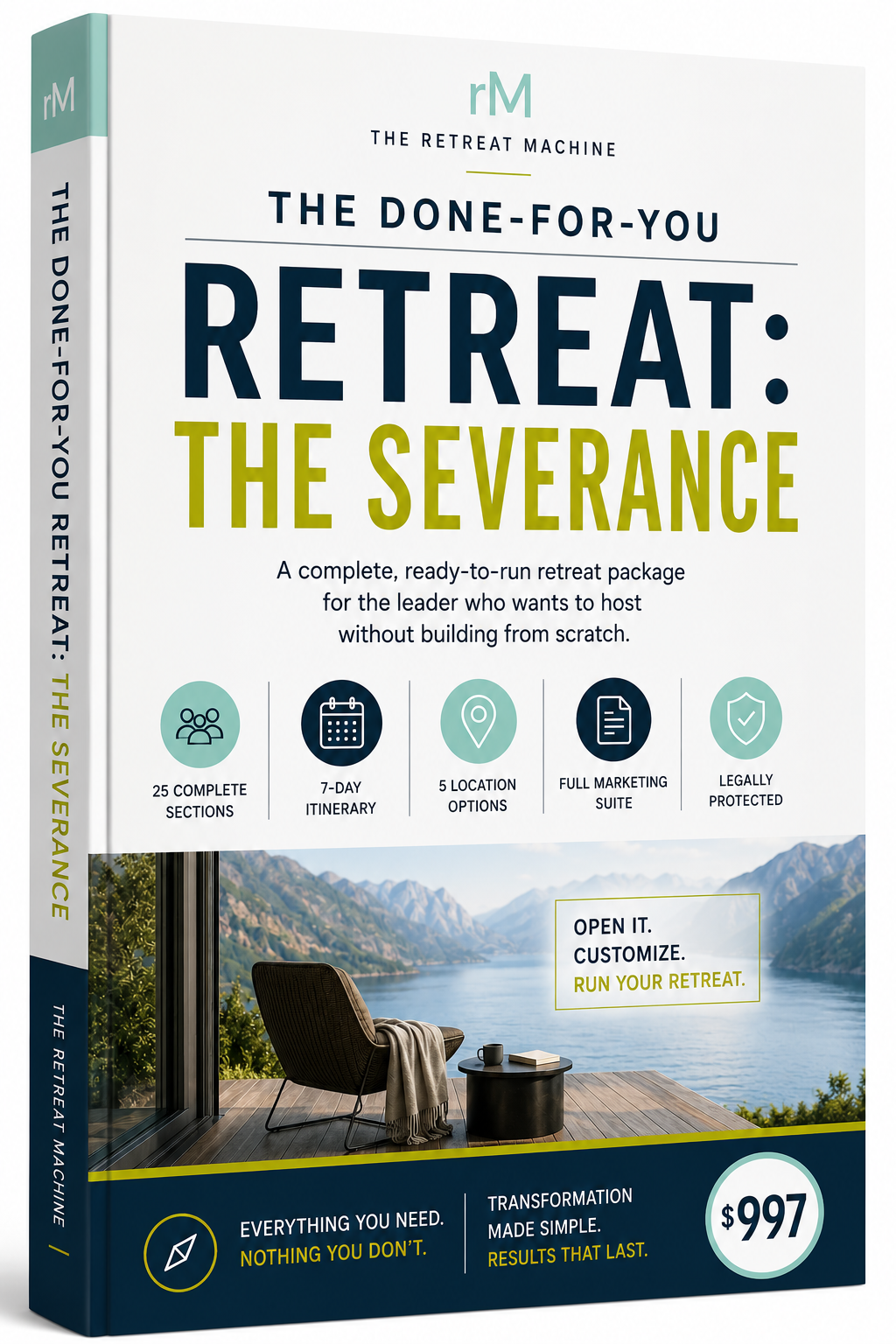
The Severance — Done-For-You Retreat
A complete, 45-page, ready-to-run seven-day retreat package for the person whose career ended without their permission. Concept, marketing, ops, and legal — done.

The Book of Ceremonies
Twelve complete opening and closing ceremonies that turn any retreat into an unforgettable experience. Scripts, setup guides, and variations included.

The Book of Icebreakers
Twelve proven experiences that turn strangers into a community.